Monday, 18 March 2019

Cargo Train Services From Lagos To Kaduna To Commence In April

Barring any last minute change, the evacuation of cargoes by rail from Apapa seaport in Lagos to the Kaduna Inland Container Dryport will commence in April, 16 months after it was commissioned by President Muhammadu Buhari.

According to LEADERSHIP newspapers, the executive secretary of the Nigerian Shippers’ Council (NSC), Mr Hassan Bello said the Nigerian Railway Corporation (NRC) has designated 24 flatbed wagons for evacuation and transportation of cargoes from the dryport. Bello stated that the rail evacuation of cargoes is another stage for the actualisation of the Kaduna dryport. He also explained that the flatbed wagons are already on the ground and would be deployed in April.

He said: ‘‘We just held a meeting now with NRC and they have so far been involved in the dryport that we now have about 24 flatbed wagons designated for Kaduna dryport. The wagons are on the ground now and by April, movement of cargoes will begin from the seaports to Kaduna and that will be another stage for the actualisation of the Kaduna dryport.’’

The Shippers’ Council boss, however, frowned at reports that Togo and Ghana are taking over as the hub in West and Central Africa sub-region. He disclosed that Nigerian ports have become efficient and effective, with 80 percent of cargoes coming to West and Central Africa from around the world destined for Nigeria seaports.

“For cargoes coming into West and Central Africa sub-region, Nigeria has 80 percent of the cargoes while other countries distribute 20 percent among themselves. So, how can they be a hub when Nigeria ports are becoming efficient by the day? We are attracting cargoes from other ports and the moment we get our infrastructure and our connectivity right, importers will patronise the eastern ports.

“The government is tackling insecurity, once that is done, then we will see the real hub. We have the Lekki deep seaport with its huge capacity and when the Lekki deep seaport comes on board, we will get bigger ships and send the smaller ones to other countries”, he said.

Bello, who also spoke on the registration policy initiated by the Council, noted that it is a step towards automating the port and cutting human interface that breeds corruption. According to him, there are lots of benefits inherent in the policy which includes easy payment at the ports.

Labels: , , , ,

Sunday, 30 December 2018

Itakpe Warri Rail: Test Run Of Trains Commence At Agbor - Photos


This is the Uromi Train Station heading towards Agbor. All is now set for the official kick-off of the Itakpe Warri Rail. The train did a test run today to see the effectiveness and also to see how well the contractors have faired.

It may be recalled that the 327km Standard-Gauge Itakpe Warri Rail links Itakpe in Kogi State To Ajaokuta and then to Warri, Delta State (Itakpe to Ajaokuta, 50KM; Ajaokuta to Warri, 277KM).

The Itakpe Warri Rail Line was started by President Babangida circa 1987, it was planned as a freight-only Rail, serving the Iron Ore / Steel belt between Aladja and Ajaokuta. It is now being reconfigured as a PASSENGER + Freight Rail, to maximize usefulness.

These are photos from the site at Uromi Train Station.


Construction Site


Labels: , , ,

Thursday, 22 November 2018

Lagos-Kano Railway Project Will Cost N4trillion – Amaechi

According to Channels TV, the Minister of Transportation, Rotimi Amaechi says about N4 trillion is required to complete the Lagos to Kano standard gauge rail project.

Amaechi said this on Thursday while addressing journalists in Kaduna State.

According to him, this is the reason why the project has been moving at a slow pace because the huge amount of money is required to finance its speedy completion.

“Doing Lagos-Kano, we are looking for about N3trillion and N4trillion. Is that a money you get easily? The budget is between N7trillion to N8trillion, if we give only Lagos-Kano the sum of N4trillion then we will be giving half of the budget and we won’t be able to pay salaries.

“So it is a gradual process, that’s why we want to rehabilitate the narrow gauge so that while we are slowly constructing the standard gauge, things will be running on the narrow gauge,” he said.

Amaechi added that the project when completed, will boost socio-economic activities in the country.

He also disclosed that the Federal Government is rehabilitating the narrow gauge rail lines to enable the trains shuttle between the south to the northern part of the country pending the completion of the standard gauge.

Meanwhile, these are pictures of the Lagos-Ibadan Railway project


Labels: , ,

Thursday, 11 October 2018

More Pictures of the Lagos-Ibadan Railway Construction


AutoReportNG did a report about the Lagos-Ibadan Rail Guage earlier today. While some are quick to lay claims that the pictures are old, some said the pictures are from Zambia and so many other claims. Well, we have decided to release more pictures from the construction of the Lagos-Ibadan Rail Guage.

This is the casting of all culverts and bridge piers which was completed on 28 September 2018. Beam and track laying is now in full speed. See more pictures below..


Labels: , , , ,

Update from the Lagos-Kano Standard Gauge Rail - Photos


Work has started in earnest at the Lagos-Ibadan (156.5 km double track); Phase II of the Lagos-Kano Standard Gauge will easy and increase passenger movement and evacuation of goods from the seaports and industrial clusters in Lagos and Ibadan; thus boosting economic activities in the areas. The Lagos-Kano Standard Gauge rail construction started last year and so far the rate of the work has been impressive. These are pictures from the site...


Labels: , , , ,

Thursday, 16 August 2018

Lists of countries that started and completed their Rail Mass Transit after Lagos Rail


Nigeria with a population of 180 million people with diverse tongues, cultures, and languages. Nigeria is blessed with intelligent, smart, mobile and creative people, this can be seen all over the world as in the case of research, analysis, medicine, peacekeeping, we are a force to reckon with. As good as this attributes are to us, we seem to lag behind in terms of growth, and what it takes to keep up. Its no doubt that the government as an institution is trying its best for growth and also by creating a conducive atmosphere for investors to invest in. One of this the Lagos Blue Rail Transit.

The Lagos Rail Mass Transit is an urban rail system being developed and under construction in Lagos. The system is being managed by the Lagos Metropolitan Area Transport Authority (LAMATA) and is envisioned to consist eventually of seven lines. The railway equipment including electric power, signalling, rolling stock, and fare collection equipment will be provided by the private sector under a Concession Contract. LAMATA is responsible for policy direction, regulation, and infrastructure for the network.

The first section of the network, Phase I of the Blue Line, was originally planned to be completed in 2011. After many delays caused by funding shortfalls, the opening date was revised to 2018 but just recently, the Lagos state government has said the project will now be completed by 2022 so technically, The Lagos Rail Mass Transit will take 19 years to complete. According to reports from Lagos state government, a total of $600million has been spent so far and still counting now that the contract has been awarded to Alstom SA of France.

These are lists of African countries that started and completed their Light Rail Mass Transit after Lagos began its construction and they have completed it.

1. Ethiopia

Addis Ababa Light Rail is a light rail transportation system in Addis Ababa, Ethiopia. A 17-kilometre (11 mi) line running from the city centre to industrial areas in the south of the city opened on 20 September 2015, inaugurated by Prime Minister Hailemariam Desalegn. Service began on 9 November 2015 for the second line (west-east). The total length of both lines is 31.6 kilometres (19.6 mi), with 39 stations. Trains are expected to be able to reach maximum speeds of 70 km/h (43 mph).

The railway was contracted by the China Railway Group Limited. The Ethiopian Railways Corporation began construction of the double track electrified light rail transit project in December 2011 after securing funds from the Export-Import Bank of China.[10] Trial operations were begun on 1 February 2015, with several months of testing following that. It is operated by the Shenzhen Metro Group.

The final cost to build the railway was US$475m, with construction taking three years. The Addis Ababa Light Rail was originally to have a total of 41 stations on its two lines, and each train was planned to have a capacity to carry 286 passengers. This will enable the light rail transit to provide a transportation service to 15,000 passengers per hour per direction (PPHPD) and 60,000 in all four directions. The railway lines have their own dedicated power grid.

According to CREC, the system carried on average 113,500 daily passengers in January 2016 with 153,000 passengers as highest passenger load during a single day. Service frequency was 10 minutes during peak hours on both lines and 20 minutes during off-peak hours. On average there were 94 train rotations on the Blue line (3,177.2 vehicle-kilometer) and 93 rotations on the Green line (3,236.4 vehicle-kilometer).


Algeria

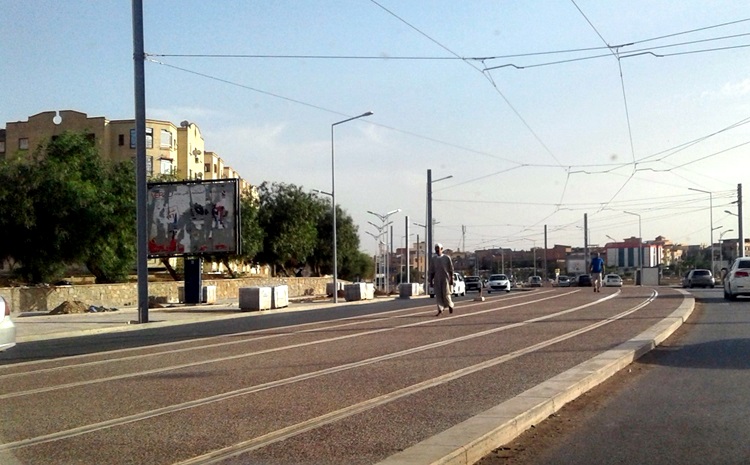
Alstom-manufactured Citadis trams have started commercial operations at Sidi Bel Abbes, a city located in the north-western part of Algeria.

The Government of Algeria's Minister of Transport and Public Works Abdelghani Zaalane inaugurated the new services in the presence of other officials.

Alstom was originally contracted to deliver 30 Citadis trams in December 2013.

Alstom Algeria president Henri Bussery said: “With Sidi Bel Abbes, we are pursuing our partnership with Algeria to provide its inhabitants with the most environmentally friendly, comfortable transport system in existence: the tram.

“To date, the cities of Algeria have ordered 128 Citadis tram units to meet the mobility needs of passengers.”

The trams will operate on a line measuring 14.3km and are capable of carrying 302 passengers.

The 44m-long Citadis trams feature seven modules, low floors, and 12 side doors to ensure comfortable passenger movement, even for commuters with reduced mobility.


Morrocco

The Rabat-Salé tramway (In French: Tramway de Rabat-Salé) is a tram system in the Moroccan agglomeration of Rabat and Salé cities which opened on 23 May 2011.

The network is 19.5 km (12.1 mi) long with 31 stops has two lines (1 and 2) with combined section and frequency interval 8 min in peak hours and has calculated ridership 172,000 passengers per day. It is operated by Transdev with Alstom Citadis articulated modern trams consisted of two 5-pieces parts. Lines uses special new Hassan II bridge over the Bou Regreg and passes near Rabat-Ville station and through a specially arranged aperture in medieval city's wall. Expansion of existing lines and two more lines (3 and 4) are under construction with opening scheduled for 2018. From the 1910s to 1930s an old steam and oil tram network existed in Rabat. It is operated under contract by Transdev.

Construction of the network began in February 2007, opening on 23 May 2011. In January 2017, a seven-kilometer extension


Labels: , , , ,